
Natural Geometry: Why the Forest Calms and the City Screams
Walking through an old-growth forest feels peaceful for a reason—your body recognizes its own geometry in the spirals, fractals, and patterns around you. What if we could bring that same calm to the digital world?
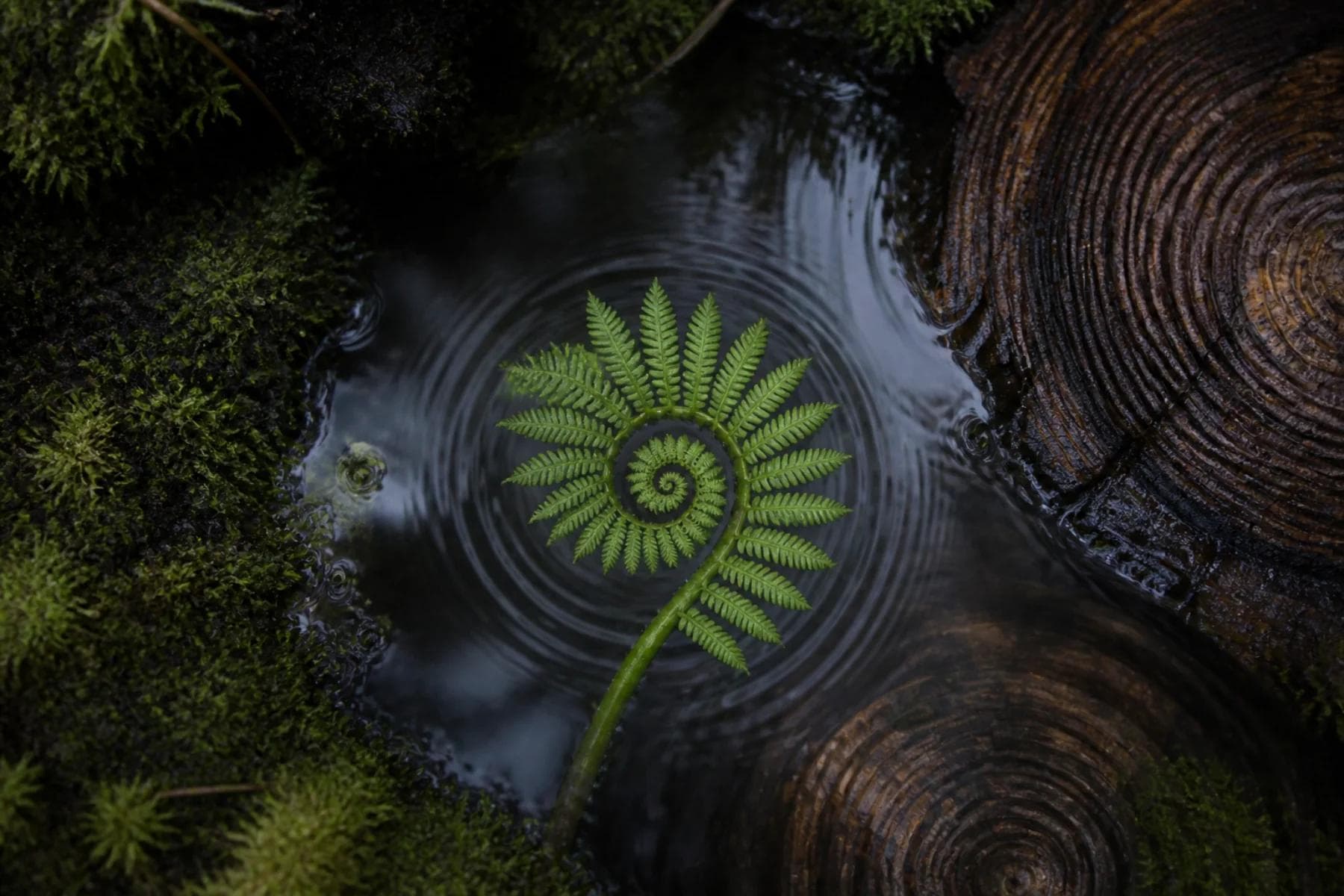
Imagine walking through an ancient old-growth forest, with cedar trees reaching for the heavens and mist drifting gently among the gnarled trunks. A nearby stream tumbles over rocks, making sweet music that drifts through the air. Adding to this refrain are the faint sounds of your footsteps on the mossy ground, your boots sinking slightly into the good earth. Far up in the branches a raven cries, her song echoing through the chill morning air like a prayer.
How did that thought make you feel? Relaxed? Peaceful?
Have you wondered why that is?
The Geometry We Know in Our Bones
One reason is that you are surrounded by natural patterns and geometry, and we naturally respond to these shapes in a positive way. They bring us solace, granting us that feeling of being home—or at least where we should be.
Compare this with the hard, unyielding surfaces and sharp 90-degree angles of the urban environment. The bright, artificial colors that scream for your attention, carefully crafted to kidnap your gaze whether you consented or not. While the forest whispers and soothes, the city screams and abuses our senses.
But what are these natural patterns for which we yearn, this organic geometry that soothes the soul?
Nature's Mathematical Perfection
Consider the snowflake. Far from being a random shape, every snowflake is composed of ordered, structured, repeating mathematical patterns. Natural geometry at its best!
In the same vein, we have the spiral. In mathematics it's known as the Golden Spiral, and its manifestations are all around us. Pick up a pine cone and look at it carefully—you'll see the scales form two sets of spirals.
Gaze at a spider's web, shimmering with dew in the morning light, and you may see a near-perfect spiral. Sit by the stream and watch as the clear waters flow over and around moss-covered rocks, spirals appearing and disappearing before your eyes. Pick up a leaf, and you may notice a near-perfect five-armed pattern. Find a felled tree and see the concentric rings, each one marking the passage of time in the forest's slow, natural rhythm.
Your Body Recognizes Itself
When you walk into a forest, you are—quite literally—stepping into geometry that resembles your own biology. It is a return to a pattern your body recognizes instinctively, like seeing your reflection rippling in a pond.
Your mind settles into these patterns naturally because it knows them. Not consciously, but deep in the bone and blood.
The branching of cedar limbs mirrors the branching of our neurons. The meandering shape of the stream resembles the paths carved by our own vasculature. These fractal patterns—endlessly repeating at every scale—are the architecture of both the forest and the human body.
So of course we breathe easier among them. We are surrounded by a geometry we instinctively understand.
The Science of Fractal Fluency
Researchers studying "fractal fluency" have found that our brains process natural fractals with astonishing ease. The visual cortex is tuned—evolutionarily tuned—to interpret these shapes with minimal effort.
This low-effort processing triggers a parasympathetic response: the same nervous system shift that happens when you breathe out long and slow, or settle into warm water. Research has shown that fractals with a mid-range complexity (nature's sweet spot) reduce stress by up to 60%.
So when you say the forest "feels good," you aren't just being poetic—you're describing a measurable physiological reaction.
Your body is relaxing because it recognizes its own geometry in the world around it.
The Bridge Between Moss and Microchip
And this is where the bridge forms between moss and microchip.
Fractals are not merely natural; they are mathematical. Code can replicate them. Interfaces can gesture toward them. When we design with soft repetition, gentle variation, branching paths, natural gradients, and organic asymmetry, we aren't decorating our apps—we're tuning them to the nervous system.
Instead of reaching for the neon color palette, choose natural hues like forest green, cedar brown, or mist grey. By building a natural color palette, you already create a peaceful and tranquil atmosphere where people are more likely to stop and breathe.
Skillful use of JavaScript can create subtle transitions from section to section. Instead of jumping from screen to screen like an over-stimulated squirrel, slow things down a tiny bit. A click on an anchor tag triggers a smooth scroll. A quick fade turns a carousel into a relaxing journey through the content.
While I realize audio is a controversial element in web and app design, a subtle use of gentle sound effects can highlight the experience and further sustain the feeling of a peaceful oasis.
An Invitation, Not a Competition
The Internet is full of hyper-stimulation: loud colors and stark designs compete for your attention. It's the visual equivalent of people screaming at you with megaphones.
By anchoring your design in organic hues, natural rhythms, and fractal patterns, you refuse to compete for attention. Instead, you offer a resting place.
The Web is a crazy, frenetic place.
Sit down and relax with me a while.